Congress puts a price tag on the Iran war
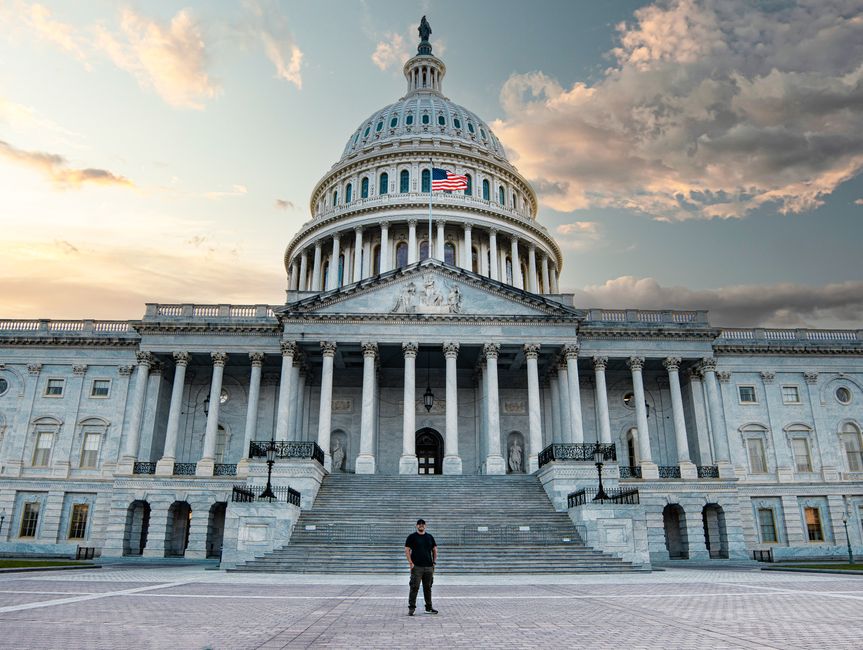
The House passed a $1.15 trillion defense bill and a separate $95 billion reconciliation framework for Iran war spending — but Senate passage is far from guaranteed.
Probable’s read
Low confidence. Based on historical base rates and cited reporting; no liquid market priced this question.
Major reconciliation bills reaching the Senate floor face historical passage rates closer to 40–50% when the House has already acted, but the Iran war context, ongoing combat operations, and the unusual SAVE Act attachment introduce significant uncertainty on Senate dynamics. No prediction market is pricing this, so we anchor near the regulatory/legislative base rate of 30% from the cross-check and adjust modestly upward to 35% given the news that six House Democrats crossed the aisle and Speaker Johnson successfully muscled through the framework — suggesting a coalition that, while narrow, has some bipartisan cover. Our range is realistically 15–55%.
The question. Will the Senate pass a reconciliation bill funding the Iran war by December 31, 2026?
What’s likely. The House moved fast — passing both a $1.15 trillion annual defense authorization bill and a separate $95 billion GOP reconciliation framework for Iran war funding in the same session, according to The Washington Post and CBS News. Six Democrats crossed the aisle on the defense authorization bill, per The Hill — but that was a separate vote from the reconciliation framework. The reconciliation bill was bundled with the SAVE Act and voter ID measures, per The New York Times and CBS News, a package that gives Senate members multiple reasons to object beyond the war itself. The harder test is the Senate, where reconciliation rules, procedural objections, and individual senators' concerns about open-ended war funding — amplified by the SAVE Act attachment — could slow or block passage. Probable puts the odds of Senate passage before year-end at 28%, with real uncertainty in both directions and a range of roughly 12 to 50 percent.
The synthesis
How Probable got to 28 percent
No prediction market has priced Senate passage of this specific bill, so Probable is working from the legislative base rate and the news reporting alone — which is why confidence is low and the range is wide. The cross-check classifies this as a REGULATORY story type with a 30% historical base rate; that is the right anchor because the question is whether a complex, multi-provision bill clears both chambers within a single year, a category where failure is the more common outcome. The House action is real and significant: The New York Times, CBS News, The Washington Post, CNBC, and NBC News all led with it, and AP News reports the defense bill includes a renaming of the Department of War. However, the red team's distinction is well-grounded in the sources: the six Democratic crossovers per The Hill were on the defense authorization bill, not the $95 billion reconciliation framework. The New York Times and CBS News both report that the reconciliation framework was bundled with the SAVE Act and voter ID measures — a package that gives Senate Democrats and moderates multiple independent reasons to object beyond war skepticism alone. Rubio's own public characterization of Iran as 'not serious about a deal,' per AP News, may further complicate Senate pressure for conditions on funding rather than an open-ended commitment. We set the probability at 28%, just below the base rate, reflecting that the SAVE Act attachment is a genuine structural obstacle the draft underweighted. The honest range runs roughly 12 to 50 percent.
Why it matters to you
The bills would lock in roughly $1.25 trillion in combined defense and Iran war spending for at least a fiscal year — shaping both ongoing military operations and the broader fiscal picture heading into midterms.
What to watch
Watch whether Senate leadership schedules a floor vote on the reconciliation framework before the August recess — if no vote is scheduled by early August, the year-end deadline for passage becomes substantially less likely.
Further reading
- The Washington Post — “House passes $1.15 trillion defense bill, tees up billions more for Iran war”
- The New York Times — “House Adopts $95 Billion G.O.P. Budget for Iran War”
- CBS News — “Speaker Johnson muscles through plan to fund Iran war and promote Trump's 'SAVE America Act'”
- The Hill — “6 Democrats cross aisle, join GOP to back annual defense policy bill”
- CBS News (Iran War Updates) — “U.S. launches 12th straight night of strikes as threats to oil trade deepen”
- Politico — “Trump's split screen: War and campaigning”
Also on Probable today
The Fed's July decision is essentially settled
Polymarket traders have overwhelmingly priced in a rate hold at next week's FOMC meeting. With no cut and no hike expected, the real question is whether the war-driven oil spike changes the calculus.
Oil at $90 is nearly certain — $95 is a coin flip
With U.S. strikes on Iran entering week two and Houthi attacks on Saudi tankers, crude is surging. Markets say WTI hitting $90 this month is close to done; $95 is where it gets genuinely uncertain.